AUTONOMOUS AI for MARITIME SAFETY & RESILIENCE
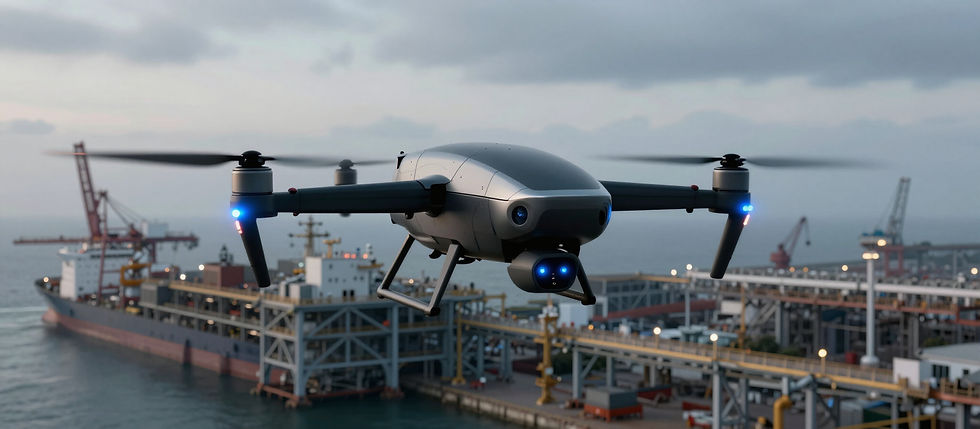
INTEGRATING AI, MARITIME DRONES & MULTI-MODAL SENSORS
We are an international consortium of twenty European partners dedicated to the development of next-generation inspection and maintenance technologies for maritime critical infrastructure. Our mission is to bridge the gap between complex engineering and intelligent automation.
THE ADVISOR INITIATIVE

The ADVISOR project addresses a multifaceted problem in the Unmanned vehicle (UxV) industry – the lack of seamless interoperability between different classes of drones: airborne, under- and on- water.
The ADVISOR framework enables efficient development, testing, and execution of UXV/swarm-based maritime inspection systems. It provides capabilities to manage various aspects of intricate processes, workflows, and interactions, contributing to the early detection of issues, ensuring the reliable and safe operation of UXV/swarms.
With solutions that boost efficiency, cut costs, enhance security, and reduce environmental impact, the project promises substantial industry impact across sectors. The consortium comprises 20 partners from The Netherlands, South Korea, Turkey, Denmark and Portugal.
Core Technologies
01
Multi-modal Sensors
We integrate high-resolution LiDAR, thermal and RGB imaging, magnetometers, sonars and acoustic monitoring to provide comprehensive structural health assessments of critical maritime assets.

02
Swarms of Drones
Our airborne (UAV), on-water (USV) and under-water (AUV) drones employ advanced navigation algorithms and obstacle avoidance to perform complex inspections in hazardous or hard-to-reach maritime environments.

03
AI Analytics
We leverage machine learning to process vast sensor data sets, combine different modality data to identify subtle anomalies, detect defects, identify deterioration and predict maintenance needs before failures occur.

Key Use Cases

Underwater Inspection by USV & ROV Swarm

ADVISOR introduces an integrated USV and ROV system designed for comprehensive inspections in maritime environments. This innovation streamlines the examination of various underwater structures, including bridges, port facilities, dams, renewable energy installations, and underwater cables. By utilizing remote sensing capabilities, the system allows for efficient surveys over large maritime areas and employs Multibeam echo sounders to collect 3D point cloud data for evaluating protective facilities around subsea structures. Subsequent integration of the ROV onto the USV facilitates real-time monitoring and visual data capture, enabling thorough assessments of these underwater structures' conditions.
Offshore Windpark & Turbine Inspection

This use case targets a teamed AV solution that is be able to autonomously inspect offshore wind turbines, pushing the SotA on AV autonomy, USV & UAV teaming and sensor data analysis/fusion. The solution includes three development clusters: 1. Drone-enabled acoustic, IR, RGB sensor data is fused together in one AI pipeline for inspection of blade defects. 2. Automated launch-and-recovery robotics system to capture (take-off, landing, and charging) airborne drones by an autonomous vessel. 3. Situational awareness for the autonomous vessel navigation system in GNSS-denied environment.
Heterogeneous Cooperative Acoustic Sensing for Offshore Infrastructure Security

We explore the heterogeneous cooperative perception between underwater acoustic sensing wireless devices and unmanned vehicles, aiming at detecting, classifying, and tracking non-authorized surface vessels, but also protecting marine life which may cause harm or be harmed by the offshore infrastructure. UAVs and UUVs will cooperate by enhancing perception, but also supporting offloading of intensive computational tasks e.g. vessel and marine life classification. In addition, UAVs will relay data towards monitoring facilities, providing additional coverage and communications support to UUVs.
Remote Vessel Pilotage

ADVISOR is one of the first to use UAV swarms for vessel pilotage operations. The key innovations are required: 1. Improved ship-to-shore connectivity with use of wireless technologies. 2. Remote management of pilotage services by collecting on-board navigation data and deploying a network of remote sensors like drones capable of communication and data transmission in real-time. 3. Swarm orchestration system for global awareness and centralized management. 4. Improved decision-making tools with optimization of services in the straits.
EFFICIENCY THROUGH AUTONOMY - MARITIME SAFETY REDEFINED